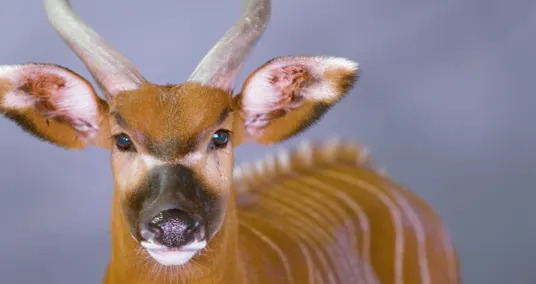
Deep within the forests of Kenya lives one of the most striking yet elusive antelopes in the world, the eastern bongo. Recognised for its rich chestnut coat marked with bold white stripes, this animal stands out as one of Africa’s most visually unique species. Despite its large size, the eastern bongo remains shy and rarely seen in the wild. It inhabits only a few isolated mountainous forest regions in Kenya, making its presence both special and fragile. Adult bongos can weigh between five hundred and nine hundred pounds, with long spiralling horns that can reach up to forty inches. These horns are not only impressive in length but also proportionally wide, matching the animal’s body size. As herbivores, bongos feed on leaves, shrubs, and forest vegetation, relying on dense cover for protection. They are most active during twilight and dusk, when low light helps them avoid predators. This behaviour, combined with their cautious nature, makes them difficult to observe even for experienced wildlife researchers. Their environment plays a crucial role in their survival, as the forests provide both food and shelter. However, this delicate balance is now under serious threat, placing the eastern bongo among the most endangered animals in Africa today.
The eastern bongo’s population has declined dramatically over time, with estimates suggesting that only around one hundred individuals remain in the wild. This number places the species well below the threshold for critical endangerment and highlights the urgency of conservation efforts. The primary threats facing these animals include illegal hunting and the destruction of their forest habitats. As forests are cleared for agriculture and human settlement, the safe spaces that bongos rely on continue to shrink. In response to this crisis, conservation organisations and local authorities in Kenya have taken important steps to protect the species. Certain forest regions have been designated as protected areas, allowing bongos to move freely without the constant threat of poaching. These efforts aim to stabilise and eventually increase the population, though recovery remains a long term challenge. Protecting the eastern bongo is not only about saving a single species, it is also about preserving the biodiversity of Kenya’s unique ecosystems. Each animal plays a role in maintaining ecological balance, and the loss of one can have wider consequences. The story of the eastern bongo serves as a powerful reminder of the impact human activity can have on wildlife and the importance of continued conservation action.
latest_posts
- 1
 Beyond the habitable zone: Exoplanet atmospheres are the next clue to finding life on planets orbiting distant stars
 - 2Songbirds swap colorful plumage genes across species lines among their evolutionary neighbors
- 3Nature's Treats: 10 Organic products That Lift Prosperity
- 4Meet ‘NASA Mike,’ who’s done 105,000 handstands around the world
- 5Lilly becomes first healthcare firm to join trillion-dollar club, Wall Street reacts


- China’s new condom tax will prove no effective barrier to country’s declining fertility rate
- Poll: Only 25% of Americans think Trump has 'followed through' on his promise to release the Epstein files
- Oil rises above $115 and Asia stocks slide as Iran war escalates
- First stop, the Moon. Next stop, Mars? Why Nasa's mission matters
- Russia downs 16 drones heading for Moscow, mayor says
- Katz, IDF: We assassinated IRGC intelligence chief Majid Khademi
- What is ‘Auld Lang Syne’? Why we sing this song at midnight on New Year’s Eve.
- Space debris: will it take a catastrophe for nations to take the issue seriously?
- From Overpowered to Coordinated: Individual Accounts of Cleaning up