When you buy through links on our articles, Future and its syndication partners may earn a commission.

We now know how far the Artemis 2 astronauts will get from Earth — and that distance will be unprecedented.
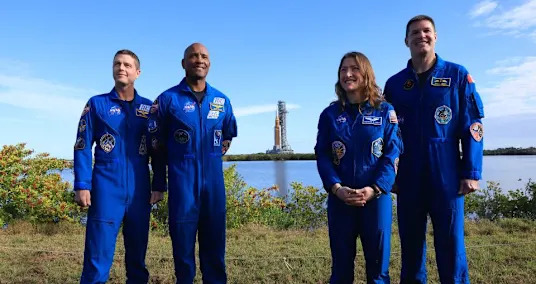
The Artemis 2 crew — NASA's Reid Wiseman, Victor Glover and Christina Koch and Canadian astronaut Jeremy Hansen — will travel a maximum of 252,757 miles (406,773 kilometers) from their home planet, NASA announced today (April 3).
The current human-distance record, set in April 1970 by the three astronauts of NASA's Apollo 13 mission, is 248,655 miles (400,171 km).
Artemis 2 will set the new mark on Monday (April 6), when its Orion capsule loops around the far side of the moon and starts heading back to Earth.
The mission was always expected to break Apollo 13's record. But the new distance estimate — which was revealed by Judd Freiling, the Artemis 2 ascent flight director, during a press briefing this afternoon — carries more weight than previous ones did.
That's because it was calculated after Orion's translunar injection (TLI) burn, a nearly six-minute-long maneuver that sent the capsule out of Earth orbit and on its way to the moon. Orion aced the TLI on Thursday evening (April 2), charting the course for the rest of the mission — and giving NASA some real numbers to crunch.
"The translunar injection burn is the last major engine firing of the mission," NASA officials wrote in the Artemis 2 press kit.
"It propels Orion on a path toward the moon and sets it on the free-return trajectory that will ultimately bring crew back to Earth for splashdown," they added. "Though only two days into the mission, it essentially doubles as Orion's deorbit burn as well."
As those words indicate, Artemis 2 will not land on the moon, or even enter lunar orbit. It was designed from the start as a flyby mission, which aims to show that Orion is capable of carrying astronauts to and from the moon. If all goes to plan, more ambitious Artemis flights will follow, including the program's first crewed lunar landing with Artemis 4 in late 2028.
Apollo 13, by contrast, was supposed to touch down on the moon. However, an oxygen-tank explosion 56 hours after launch scotched those plans and put the mission into survival mode.
And survive it did, thanks to the ingenuity and perseverance of the Apollo 13 astronauts — commander Jim Lovell, lunar module pilot Fred Haise and command module pilot Jack Swigert — and the folks in Mission Control. Lovell, Haise and Swigert made it back to Earth safely after swinging around the moon, etching their names into the history books for multiple reasons.
latest_posts
- 1
 The 25 Most Notable Style Crossroads in History
 - 2Watch Atlas V rocket launch its heaviest-ever payload early on April 4
- 3Thousands of genomes reveal the wild wolf genes in most dogs’ DNA
- 4Euclid space telescope sees gorgeous cosmic cloud | Space photo of the day for Nov. 18, 2025
- 5NASA will bring space station crew home early after medical issue



- In Antarctica, photos show a remote area teeming with life amid growing risks from climate change
- 'Pluribus' release date: Everything you need to know about the new series from 'Better Call Saul's' co-creator
- The Main 15 Applications for Efficiency and Association
- NASA’s history-making moon mission aims to send the first woman and person of color to deep space
- Brazil's agricultural research agency gets cannabis research greenlight
- Only 30% of young people in Israel optimistic about future, Aluma survey reveals
- Display of Netanyahu's severed head 'incites public to murder PM', Likud says in official complaint
- Single women risk rape and exploitation in search for better life in Europe
- Becoming the best at Discussion: Individual Procedures